

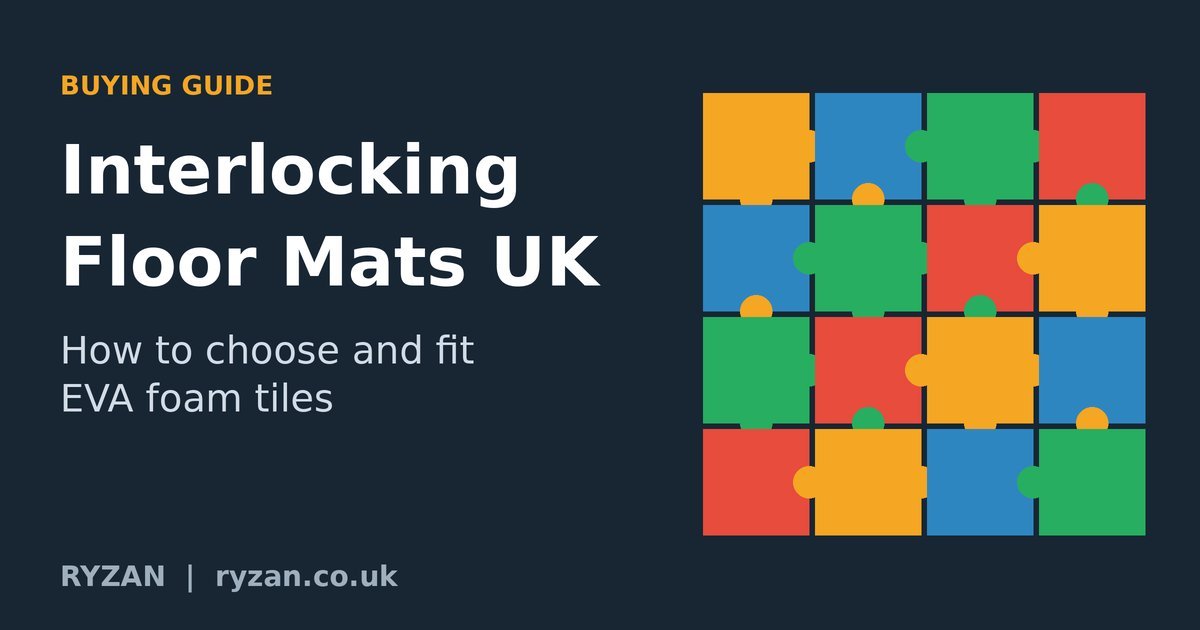
Cold, hard floors are tough on knees, toys and gym kit. Interlocking floor mats add a soft layer without glue, tools or a fitter.
Quick answer: Interlocking floor mats are foam tiles with puzzle edges that click together into one soft surface. For most homes, EVA foam tiles are the practical choice. Measure your floor, divide the area by the area of one tile, then add about 10 percent spare. RYZAN sells 30 x 30 cm and 60 x 60 cm packs, from 4 to 18 tiles.
What you’ll learn
- What interlocking floor mats are and where they work best
- How 30 x 30 cm and 60 x 60 cm tiles compare
- The simple formula for how many tiles you need
- A step-by-step way to lay and clean them
- Mistakes to avoid before you order
Contents: What they are | Why they matter in the UK | Sizes and packs | How to fit them | Checklist | Mistakes | FAQs
Ready to shop? Browse the full interlocking floor mats range.
What are interlocking floor mats?
Interlocking floor mats are square foam tiles with jigsaw-style edges. You press the edges together and the tiles lock into one floor covering. There is no glue or fixing, so you can lift them and rearrange them later.
Most are made from EVA, short for ethylene vinyl acetate. RYZAN’s product pages describe its tiles as high-density EVA foam that cushions impact and reduces noise from exercise or play. The listings also call them non-slip, water-resistant and easy to wipe clean, and suggest uses such as yoga, weightlifting, home workouts, playrooms, nurseries and garages.
Why interlocking floor mats matter in UK homes
Many UK homes have hard floors such as tile, laminate, vinyl or bare concrete in a garage or utility room. These surfaces feel cold and give no cushioning. Because foam tiles are modular, you can fit them to a small or awkward room and take them with you if you move.
They also suit home exercise. The NHS physical activity guidelines advise adults to do strengthening activities on at least 2 days a week, and they list yoga and bodyweight exercises such as push-ups among the options. A mat area makes that easier to do at home. This is general information, not medical advice. The NHS suggests speaking to your GP first if you have health concerns.
Tile sizes and pack options
RYZAN lists two tile sizes, in black and multicolour. Here is how the packs compare:
| Pack | Tile size | Tiles | Area covered |
|---|---|---|---|
| 9 pack | 30 x 30 cm | 9 | 0.81 m² |
| 18 pack | 30 x 30 cm | 18 | 1.62 m² (calculated) |
| 4 pack | 60 x 60 cm | 4 | 1.44 m² |
| 6 pack | 60 x 60 cm | 6 | 2.16 m² |
| 12 pack | 60 x 60 cm | 12 | 4.32 m² |
Coverage for the 9, 4, 6 and 12 packs follows the product pages. The 18 pack figure is calculated as 18 tiles x 0.09 m².
Smaller 30 x 30 cm tiles have more joins but fit corners and narrow spaces more easily. Larger 60 x 60 cm tiles cover ground faster with fewer seams.
| Space | What matters most | Where to start |
|---|---|---|
| Home gym | Coverage under kit, cushioning | 60 x 60 cm packs |
| Playroom or nursery | Soft, easy-to-clean surface | Either size |
| Garage or utility room | Protecting the floor, easy cleaning | 60 x 60 cm packs |
| Yoga corner | A small, clean zone | 9 pack |
How to fit interlocking floor mats
Follow these five steps to get the quantity and the finish right.
Step 1: Measure the floor
Measure the length and width in metres and multiply them to get the area in square metres. For an L-shaped room, split it into rectangles and add the areas together.
Step 2: Do the tile sum
Use this formula: tiles needed = floor area ÷ area of one tile. A 60 x 60 cm tile covers 0.36 m². A 30 x 30 cm tile covers 0.09 m².
Step 3: Add spare
Add about 10 percent for edges, trimmed tiles and mistakes. This is a rule of thumb, not a RYZAN specification.
Worked example (illustrative only): A home gym measures 3 m x 2.5 m, which is 7.5 m². Using 60 x 60 cm tiles, 7.5 ÷ 0.36 = 20.8, so you need 21 tiles. Add 10 percent, about 2 tiles, and you need 23. Two 12 packs give 24 tiles and 8.64 m², so they cover the room with one tile to spare.
Planning a bigger space, such as a gym or nursery? See RYZAN’s trade and wholesale page for larger orders.
Step 4: Prepare and lay the tiles
Sweep the floor and make sure it is dry. Start in a corner, press the puzzle edges together until they sit flush, then work outwards. Do not force a tile that will not seat.
Do a dry run first if you want a pattern. Black and multicolour tiles can be mixed to make a border or a checkerboard. Keep to one tile size per area so the joins line up.
Step 5: Clean and look after them
RYZAN’s listings say the mats wipe clean with a damp cloth. If a spill runs under the seams, lift the tiles and dry the floor beneath.
Quick checklist before you order
Run through this list before you add a pack to your basket:
- Measure the floor and write the area down in square metres.
- Pick a tile size, then work out the tile count with the formula above.
- Add about 10 percent spare.
- Choose black or multicolour, and check which pack size is in stock.
- Check the thickness. RYZAN lists the tiles as 1TH, and the 18 pack is listed as 1 cm. Ask if you need an exact figure.
- Think about the room’s use: gym kit, wet footwear or small children.
- Decide whether you need one pack or several, and check the trade page if the order is large.
Common mistakes to avoid
- Buying the exact floor area. Edges and trimmed tiles use extra, so allow spare.
- Mixing units. Tile sizes are in centimetres but coverage is in square metres. A 60 x 60 cm tile is 0.36 m², not 3,600.
- Laying on a dirty or damp floor. Grit and moisture can get trapped under the tiles.
- Comparing packs by price alone. Check the tile size, the number of tiles and the coverage first.
- Ignoring how the room is used. For very heavy equipment, check the product details and ask before you buy.
FAQs
Are interlocking floor mats good for a home gym?
RYZAN lists its tiles for home workouts, yoga and weightlifting. The EVA foam is described as high density, with impact cushioning and noise reduction. For very heavy machines, ask RYZAN to confirm suitability first.
Are they safe for babies and toddlers?
RYZAN describes the material as soft and non-toxic and lists the tiles for nurseries and playrooms. If you need test or safety documents, ask RYZAN before you buy.
How many tiles do I need?
Divide your floor area by the area of one tile, then add about 10 percent spare. A 60 x 60 cm tile covers 0.36 m² and a 30 x 30 cm tile covers 0.09 m².
Can I use them in a garage?
RYZAN lists garages among suitable places. Sweep the floor first and wipe the tiles clean when they get dirty.
How do I clean them?
RYZAN’s listings say they wipe clean with a damp cloth and resist sweat, spills and stains. Dry the surface afterwards.
Conclusion
Interlocking floor mats are a quick way to make a hard floor softer and quieter. Measure the room, divide by the tile area and add a little spare. Then pick the pack that fits the space.
Ready to order? Browse the interlocking floor mats range or contact RYZAN with your room measurements.